
Skip to content

Air Quality and Wildfire Smoke

Please note: Air quality can vary across our region, and the risk level shown in the image above may not reflect conditions in your exact location. The risk level above is based on information from Air Quality Ontario and is only increased when an air quality alert is issued by Air Quality Ontario or Environment and Climate Change Canada (ECCC).

For the most accurate information about air quality in your area, visit the AQMap to view air quality conditions from the monitoring station closest to you and follow the recommended health guidance. See below for more information on monitoring local air quality.


Sliding scale shows Low risk to Very high risk.
Risk Level AQHI Category PM2.5 (µg/m³) People at Higher Risk General Population
Low Risk 1-3 0-30 Enjoy your usual outdoor activities. Ideal air quality for outdoor activities.
Moderate Risk 4-6 31-59 Consider reducing or rescheduling strenuous activities outdoors if you are experiencing symptoms. No need to modify your usual outdoor activities unless you experience symptoms such as coughing and throat irritation.
High Risk 7-10 60-100 Reduce or reschedule strenuous activities outdoors. Children and older adults should also take it easy. Consider reducing or rescheduling strenuous activities outdoors if you experience symptoms such as coughing and throat irritation.
Very High Risk 10+ 101+ Avoid strenuous activities outdoors. Children and older adults should also avoid outdoor physical exertion. Reduce or reschedule strenuous activities outdoors, especially if you experience symptoms such as coughing and throat irritation.

*Note: The AQHI values in this table are based only on fine particulate matter, also called PM2.5. PM2.5 is made up of very small particles in the air and is measured in micrograms per cubic metre of air (μg/m³). The table includes Health Canada messages and recommended actions to help reduce exposure to wildfire smoke. People who are at higher risk, or anyone who has symptoms, should consider taking action when the AQHI is Moderate. Others may not need to take action until the AQHI reaches High or Very High.

People at higher risk include older adults, children, pregnant people, and those with heart or lung conditions. For a more complete list, please see the information below.


Air Quality Key Messages:

Outdoor air quality in Renfrew County and District is usually good for enjoying outdoor activities and generally poses a low risk, even for people who are sensitive to air pollution. However, air quality can change from day to day because of pollution from local and regional sources. Wildfire smoke can cause significant changes in air quality and increase health risks.

Wildfires and wildfire smoke have always occurred in Ontario, but climate change is making them more frequent and severe. As a result, Renfrew County and District is experiencing more air quality events related to wildfire smoke.

Wildfire smoke is a type of air pollution that can affect your health. It can irritate the lungs, cause inflammation, and worsen heart and lung conditions.

Fine Particulate mater (PM2.5) is the main health risk from wildfire smoke

There is no known safe level of exposure to wildfire smoke pollutants. Health effects can occur even at low levels, especially for people at higher risk.

Air quality can be poor even when smoke is not visible or easy to smell. As smoke levels increase, health risks increase. Local air quality information can help people decide when to reduce exposure.

If your community is threatened by an approaching wildfire, be ready to evacuate if directed by local authorities. Keep an evacuation kit prepared. For more information on what to include, visit: Your Emergency Preparedness Guide.


Wildfire Smoke and Air Quality Fact Sheet

Download our Wildfire Smoke and Air Quality Fact Sheet for a quick, printable overview of how wildfire smoke can affect your health, how to monitor local air quality conditions, and steps you can take to reduce your exposure.
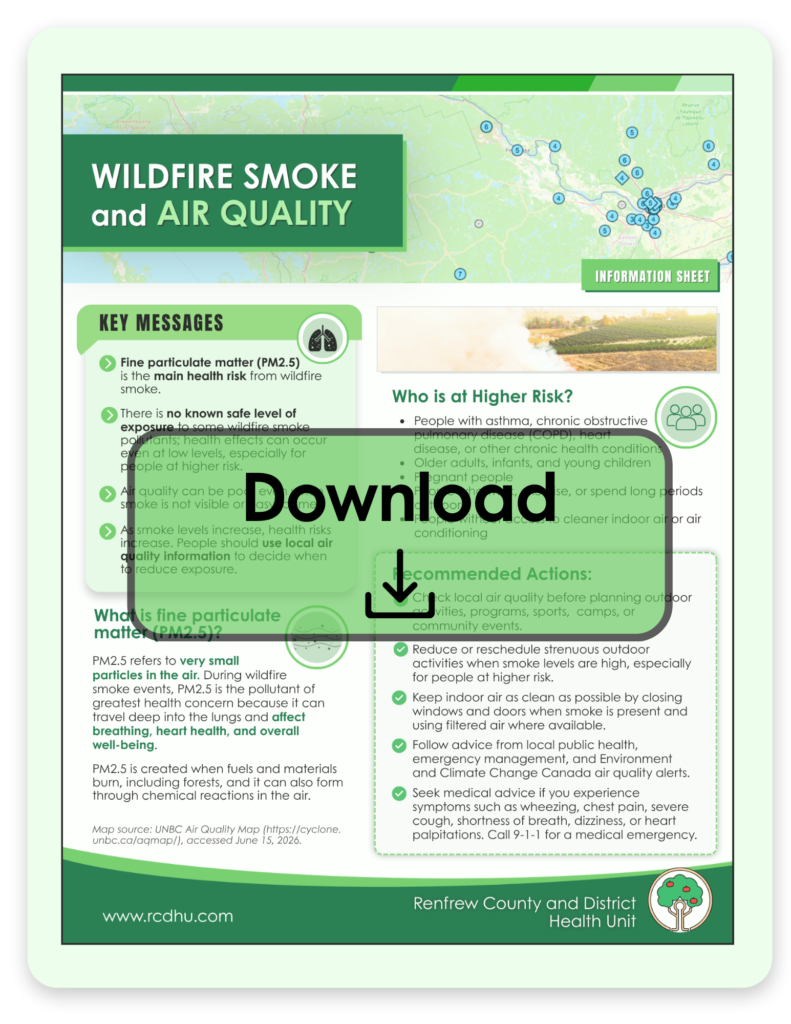
Fact sheet preview with a download icon

Wildfire Smoke

Wildfire smoke comes from burning forests, grasslands, and other vegetation. It is a complex mixture of gases, fine particulate matter, and water vapour that can change as it moves away from the fire. Wildfire smoke can affect everyone’s health, even when smoke levels are low.

The particles in wildfire smoke are very small. As smoke travels away from a fire, these particles can interact, change, and stick together.

Fine Particulate Matter (PM2.5)

PM2.5 refers to very small particles in the air. Of all the pollutants in wildfire smoke, fine particulate matter (PM2.5) poses the greatest risk to human health.

During wildfire smoke events, PM2.5 is the pollutant of greatest health concern because these microscopic particles can travel deep into the lungs and affect breathing, heart health, and overall well-being.

The best way to protect your health is to reduce how much wildfire smoke you breathe in.

Who is At Risk of Health Effects?

Everyone can be affected by wildfire smoke. There is no known safe level of exposure to wildfire smoke. Health effects can happen even at low smoke levels, especially for people at higher risk. Taking steps to reduce your exposure can help protect your health.

Some people are more likely to experience health effects from wildfire smoke, including:

  • older adults
  • pregnant people
  • infants and young children
  • people who work outdoors
  • people involved in strenuous outdoor exercise
  • people with existing illness or chronic health conditions, such as cancer, diabetes, lung or heart conditions

When air quality is poor, people at higher risk are encouraged to limit time outdoors as much as possible. Everyone can consider reducing, changing, or rescheduling outdoor activities until air quality improves.

During wildfire smoke events, check on people in your care and others who may be more sensitive to smoke, especially during periods of poor air quality.

There is no known safe level of exposure to wildfire smoke. Health effects can happen even at low smoke levels, especially for people at higher risk.


Health Effects of Wildfire Smoke:

Wildfire smoke can affect everyone differently. Symptoms can range from mild to serious.

Mild symptoms of smoke exposure can usually be managed without medical intervention, and include the following:

  • Headaches
  • A mild cough
  • A runny nose
  • Production of phlegm
  • Eye, nose, and throat irritation

More serious symptoms include:

  • Dizziness
  • Chest pains
  • Severe cough
  • Shortness of breath
  • Wheezing (including asthma attacks)
  • Heart palpitations (irregular heartbeat)

If you experience any of these symptoms, talk to your health care provider or seek medical attention immediately.

Tips to prepare for wildfire smoke events:

You can do many things to prepare yourself and your home for wildfire smoke events. Consider the following questions to help prepare you for exposure to wildfire smoke:

  • Are you or is someone in your family at risk for wildfire smoke health effects?
  • Do you have an adequate supply of medications?
  • Do you have an adequate supply of food and water?
  • Do you have spare filters for the air filtration unit (a high efficiency heat ventilation air conditioning (HVAC) system or a portable air cleaner) in your home?
  • Do you know where you can go to take a break from the smoke?
  • Do you know where to find information about local air quality conditions?
  • Did you Download the WeatherCAN app, available on iOS and Android devices, to receive free notifications about weather events, extreme heat and special air quality statements?

Tips to keep smoke out of your home:

  • Keep windows and doors closed as long as the temperature is comfortable. Seal any large gaps.
  • Use recirculation settings on your HVAC system to prevent smoke from entering your home. Turn on your air conditioner to recirculate the air in the home, use ceiling fans, or portable fans rather than taking air from the outdoors, as long as the temperature remains comfortable.
  • Limit the use of exhaust fans when they are not needed, such as those like the ones in the kitchen, bathroom and clothes dryer.
  • Use a clean, good quality air filter in ventilation systems. Visit: Wildfire Smoke 101: Using an air purifier to filter wildfire smoke.
  • Use an air purifier that uses HEPA filtration to remove smoke from your home. Check out: Infographic: Protecting your indoor air from outdoor pollutants.
  • Visit community centres, libraries, and shopping malls, as these places often have cleaner filtered air and can provide a break from smoke.
  • Avoid indoor pollutants such as tobacco smoke, heating with wood, frying or boiling foods, burning candles and using paints/adhesives.

If your community is at immediate risk from poor air quality caused by dense wildfire smoke, Environment and Climate Change Canada (ECCC) may issue an Air Quality Alert.

The Ministry of the Environment, Conservation and Parks (MECP) operates 38 air monitoring stations across Ontario:

  • These stations collect real-time air quality data and measure key pollutants that indicate overall outdoor air quality.
  • Monitoring stations are not located in every community. The stations closest to Renfrew County and District are in Dorset, North Bay, and Ottawa.

Air quality information from these stations is shared publicly through the Air Quality Health Index (AQHI) or by visiting Environment and Climate Change Canada’s: Air Quality Health Index – Ontario.

General information about Ontario’s air quality monitoring program is available at Air Quality Ontario. AQHI values are updated hourly by ECCC, 24 hours a day, 7 days a week.

Public health messaging during wildfire smoke events is guided by real-time air quality information, including PM2.5 levels and the Air Quality Health Index (AQHI). In Ontario, when 1-hour PM2.5 reaches or exceeds 60 µg/m³, the AQHI is reported as 7 or higher, which is in the high-risk category.

Air quality can change quickly, especially during wildfire smoke events. Organizations are encouraged to monitor local conditions in real time and make decisions about outdoor activities, events, programs, and services based on the most current information available. RCDHU recommends using multiple sources to assess local air quality conditions and risks:

Tools for Monitoring Air Quality:

To monitor local air quality, check the following real-time air quality information:

AQMap:

RCDHU has coordinated a network of PM2.5 sensors across Renfrew County and District to support local monitoring during wildfire smoke events. Check local smoke levels using PM2.5 readings at: AQMap.

  • When you open the map, it will show the current 1-hour average PM2.5 level for areas on your screen:
    • Find the monitoring site closest to your area to see air quality measurements.
    • Match that number to the PM2.5 column in the Wildfire Smoke Health Guidance table at the top of this page to find the risk level for your area.
    • Follow the health advice for that risk level.
  • The AQMap aligns with the 1-hour average PM2.5 AQHI messaging.
Trusted Local PM2.5 Monitoring Sites:

The following locations currently have air quality monitors. These measurements appear in the AQMap listed above.

  • Renfrew: PurpleAir monitor
  • AQSU-Petawawa-2: PurpleAir monitor
  • Pembroke: PurpleAir monitor
  • AFFES-Smoke Lake: PurpleAir monitor

*Please see disclaimer statement below for more information.

Air Quality Ontario – Observation and Forecasts:

Check regional air quality conditions and forecasts through Air Quality Ontario at: Air Quality Health Index (AQHI).

  • Check the Air Quality Health Index (AQHI) for the monitoring station closest to you. Use the risk level shown there and follow the health advice for that level.
    • The Ministry of the Environment, Conservation and Parks (MECP) has 38 air monitoring stations across Ontario. None of these stations are in Renfrew County and District (RCD).
    • The closest stations to RCD are in Ottawa, North Bay, and Dorset.
  • AQHI values and daily forecasts are created by Environment and Climate Change Canada (ECCC). They are updated every hour, 24 hours a day, 7 days a week.

Disclaimer:

Local Monitoring Sites: The data shown in AQMap is collected by automated monitors in near real time. This information is preliminary and has not yet been fully reviewed or verified, so it may change without notice after quality assurance checks are completed. AQMap is provided as a public service “as is,” without any express or implied warranty about the quality, accuracy, reliability, completeness, timeliness, usability, or suitability of the information for a specific purpose. Environment and Climate Change Canada ambient air monitor stations may differ from what is currently displayed by PurpleAir or AQ egg monitors displayed on the AQMap.

Sites listed as trusted on RCDHU’s website have been reviewed to confirm that the monitor is installed outdoors and meets the manufacturer’s installation guidelines.

RCDHU does not review, verify, or guarantee the air quality data reported by these monitors.

The best way to protect your health is to reduce your exposure to wildfire smoke. Reduce or reschedule outdoor activities and spend time in cleaner indoor air whenever possible. If you must spend time in smoky conditions, a well-fitting and properly worn N95 mask can provide additional protection. N95 or equivalent masks reduce exposure to fine particles in smoke but do not protect against gases in wildfire smoke.

An N95 or equivalent mask is a special type of mask that is:

  • designed to fit snugly around your face, covering your nose, mouth and chin
  • made of materials that will filter out the fine particles in wildfire smoke

An N95 or equivalent mask is different from a cloth, medical or surgical mask. These other masks don’t fit the face well and the materials may not be effective filters against wildfire smoke. A scarf, bandana, neck gaiter or face shield won’t protect you against wildfire smoke.

N95 or equivalent masks are available free of charge at Renfrew County and District Health Unit Pembroke office. For mask availability in other areas, please contact your local municipality

Make sure you have a good fit:

It’s important to make sure your N95 or equivalent mask is well-fitting and properly worn to provide some level of protection against wildfire smoke.

  • Choose a size and shape that properly fits your face.
  • Choose an N95 or equivalent mask that fully covers your nose, mouth and chin.
  • Check for gaps between your face and your N95 or equivalent mask.The material of the N95 or equivalent mask should pull in towards your face when you inhale (breathe in).
  • Air shouldn’t escape the edges when you exhale (breathe out).
  • Improve the N95 or equivalent mask fit so it’s snug against your face and has no gaps.
    • Adjust the bands or ear loops.
    • Bend the nosepiece wire to fit snugly over your nose.
  • N95 or equivalent masks fit best on clean shaven skin. Facial hair prevents a tight fit and decreases how well the mask works.

Safe Use:

  • Replace your N95 or equivalent mask when it is dirty, damp or damaged.
  • During extreme heat events, wearing a mask may add to heat stress in some people. Prioritize staying cool.
  • Some individuals may find it difficult to tolerate mask use, particularly individuals with underlying respiratory, cardiac or other health conditions. Listen to your body.
  • If you need to remove your N95 or equivalent masks, try to move to an area with cleaner air before removing it.
  • Don’t wear an N95 or equivalent masks while sleeping.

N95 or equivalent masks should not be used by:

  • children under 2 years of age
  • someone who has trouble breathing while wearing the mask
  • someone who needs help to remove it

For more information on N95 or equivalent use during a wildfire visit: Using a respirator mask during wildfire smoke events – Canada.ca

Note for Partners:

Eligible community and public-sector organizations can order NIOSH-certified N95 masks at no cost, including delivery, through Supply Ontario by contacting sco.supplies@supplyontario.ca. RCDHU has a limited supply and may be able to support temporary access while organizations arrange their own supply. Masks should be provided with the following information sheet Using Respirators Masks During a Wildfire Smoke Event.


Development of the Wildfire Smoke Health Guidance


1-Hour PM2.5 Level:

To help residents make informed decisions during wildfire smoke events, RCDHU is using an approach developed by the British Columbia Centre for Disease Control (BCCDC). This approach combines 1-hour average PM2.5 measurements with Environment and Climate Change Canada’s Air Quality Health Index (AQHI) to assess local air quality conditions and provide clear health guidance.

This approach was used to develop the Wildfire Smoke Health Guidance by 1-hour average PM2.5 level table at the top of this page. The table was also adapted to align with Ontario guidance, which reports the AQHI as 7 or higher—in the high-risk category—when 1-hour PM2.5 reaches or exceeds 60 µg/m³. Canada and Ontario do not currently set a regulatory 1-hour PM2.5 limit specifically for wildfire smoke.


What's Happening Soon

View Our Calendar

Pembroke Office

141 Lake Street, Pembroke, Ontario K8A 5L8

Phone: 613-732-3629
Toll Free: 1-800-267-1097
Fax: 613-735-3067

Hours of Operation
Monday to Friday, 8 a.m. - 4 p.m.

Renfrew Service Hub (By Appointment Only)

120 Plaunt Street South, Renfrew, Ontario, K7V 1M5

Services offered by appointment only.

If you require an alternative accessible format or assistance accessing information on this page, please contact us at contact@rcdhu.com or 613-732-3629.